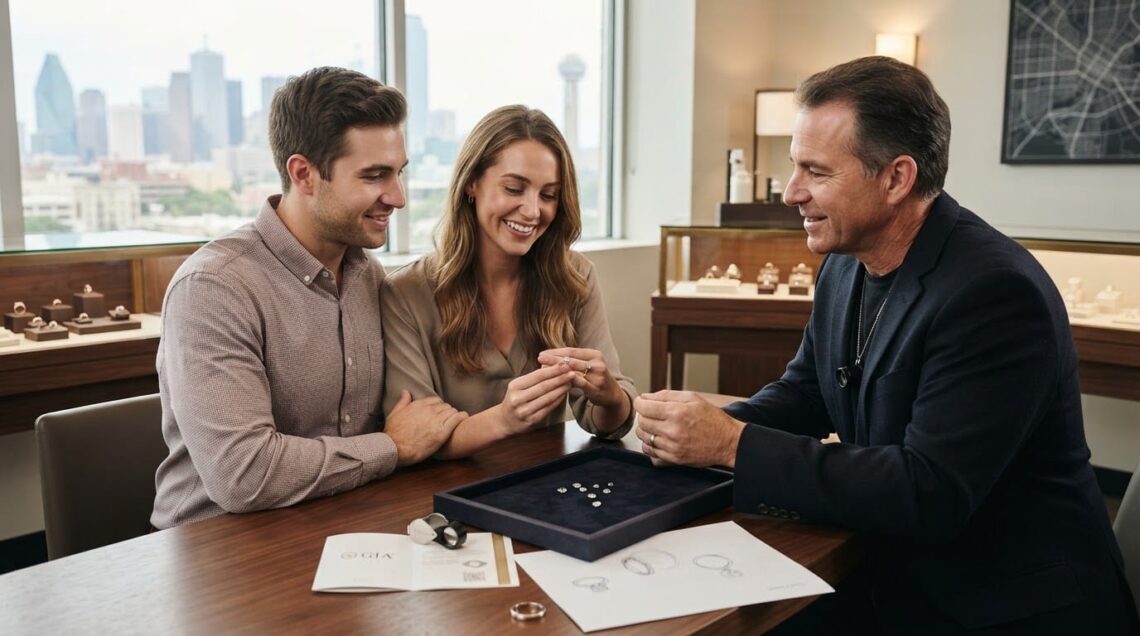
A diamond that looks flawless under a jeweler’s warm halogen lamp can look flat on a sunny patio in July, and many buyers learn this only after the proposal. The gap between showroom appearance and everyday reality is where most regrets begin, so the smartest shopping starts with the wearer’s life rather than the photograph.
Anyone beginning to research engagement rings in Dallas will find a crowded market: independent designers, large chain stores, estate dealers, and online retailers with local showrooms. Dallas buyers also face regional realities that shape the decision, including summer heat that pushes outdoor activity indoors and air conditioning that dries skin, along with a sales tax environment in which the city’s combined rate of 8.25 percent applies to most jewelry purchases. Understanding those variables before comparing price tags makes the rest of the process far easier to manage.
Buyers who want a practical framework can start with a few decisions in sequence. Whether you visit a local showroom like Shapiro Diamonds or work with another jeweler, the order matters: define how the ring will be worn, choose between custom and ready-made, verify the stone, select the metal, and only then build a budget and timeline around those choices.
Start With How the Ring Will Be Worn, Not Just How It Looks
The wearer’s daily routine determines how much exposure a setting can tolerate. Desk work is gentle, but gym sessions, cooking, gardening, and childcare involve repeated knocks against counters, car doors, and playground equipment. A setting that survives a decade of office work may need a sturdier design for someone who lifts weights or works in a kitchen.
Setting height is the central tradeoff. Low-profile settings sit close to the finger, reducing snagging on sweaters, hair, and fabric, and they are generally more comfortable for people who type or handle small objects. Elevated settings lift the stone for greater visible brilliance and make the center diamond easier to clean, but they expose the prongs and girdle to more impact. A four-prong head with a moderate crown height often balances light performance with everyday practicality.
Buyers should also consider how the ring fits future circumstances. A move to a new climate, a career change into a hands-on field such as nursing or construction, or a growing family can all change how often the ring is removed and how much stress it absorbs. A ring that works for a single apartment dweller may require a different band width or setting style after children arrive. Asking these questions early prevents expensive redesigns later.
Custom Design or Ready-to-Wear: Choosing the Right Path
Shopping from in-store inventory and commissioning a custom piece differ mainly in timing, flexibility, and cost predictability. Stock settings are visible and can be purchased the same day, with the stone often selected at the same time. A custom piece begins with a design concept, requires several weeks of production, and offers far more control over proportions and metal, but its final price can shift as details are refined.
When a Custom Piece Makes Sense
Custom work is most valuable when personal meaning drives the design. An heirloom diamond from a grandmother’s estate, a specific shade of metal that matches a family piece, or a motif drawn from a shared place or experience are all strong reasons to commission a ring. Jewelers can also remount an existing stone, though the existing mounting and the stone’s girdle thickness must be inspected first, since thin girdles are vulnerable during resetting.
A standard design consultation generally follows a predictable sequence. The client shares inspiration images and budget parameters, and the designer produces sketches or computer renderings. After a design is approved, many workshops create a wax model, which allows the client to check comfort, finger fit, and proportions before the metal is cast. Most consultations include one to three revision rounds; additional changes at later stages often add cost, which is why finalizing the wax model is the last inexpensive decision point.
Where Stock Designs Save Time
A ready-made setting is the practical choice when the timeline is tight or the buyer wants to focus on the stone itself. Stock mountings are already cast and sized, so a stone can be set and sized within days to a couple of weeks. Buyers who want to compare several diamonds side by side often find stock settings easier, because the same mounting can display different stones consistently.
Stock designs are not fixed. Many jewelers can adjust band width, prong count, and metal finish, such as high polish versus satin or rhodium plating on white gold. Changing from four prongs to six, or from a 2-millimeter to a 2.5-millimeter band, is typically a modest modification compared with a full custom build, though it still requires confirmation of the final price.
Verifying the Stone Before Committing
Any serious purchase begins with the grading report. Diamonds should be accompanied by a report from a recognized laboratory, most commonly the Gemological Institute of America (GIA), the American Gem Society (AGS), or the International Gemological Institute (IGI). Reports from these labs use standardized scales: color ranges from D (colorless) to Z (light yellow), and clarity runs from FL (flawless) through I3 (included). A report describes the stone’s measurements, cut grade where applicable, and any inscriptions on the girdle that link the report to the diamond.
Priorities depend on budget. For buyers focused on visible brilliance, cut quality usually matters most, since a well-proportioned round brilliant with excellent polish and symmetry returns more light than a larger stone with poor proportions. Color in the G-to-J range often appears white in a mounted ring, particularly in yellow gold. Clarity in the SI1 to VS2 range frequently hides inclusions from the naked eye, though a 10x loupe check remains essential. Carat weight influences size and price most directly, so buyers who must choose between weight and cut often gain more visible value by prioritizing cut.
Lighting changes perception substantially. Indoor store lighting, typically LED or halogen with a warm or neutral color temperature, can flatter a stone and mask slight yellow tones. Daylight reveals color more accurately and shows fire under varied angles. Buyers should request viewings in both settings, ideally near a window, before deciding.
Before purchasing, ask the jeweler these questions:
- Where did the stone originate, and can the jeweler document its provenance or supply the report number for verification?
- What is the return or exchange policy, and is there a time limit for returns after delivery?
- Does the jeweler provide appraisal support, including an insured replacement value suitable for insurance?
- Can the stone be viewed unmounted under a loupe and in daylight before the setting is finalized?
- Are any treatments, such as fracture filling or laser drilling, disclosed on the report or in writing?
Metal, Setting, and Long-Term Care
Platinum is dense, hypoallergenic, and typically rated 950 purity. It resists wear well but develops a patina over time that some owners prefer to polish out. White gold, usually 14 karat, is less expensive than platinum but requires periodic rhodium plating to maintain a bright white tone, commonly every one to two years depending on wear. Yellow gold in 14 karat or 18 karat offers warmth that complements warm skin tones and yellow or champagne diamonds, while 18 karat is softer and shows scratches more readily. Rose gold, which gets its color from copper alloy, flatters many skin tones and pairs well with antique-style settings, though its copper content can react with skin in some individuals.
Prongs are the ring’s primary security system, and they wear gradually. Each knock against a hard surface can bend or thin the tips, and over decades a prong may lose enough metal to allow a stone to shift. Jewelers typically inspect prongs at each cleaning and recommend retipping when the metal is thin or when a stone rotates freely. Periodic inspection every six months is a reasonable schedule for daily-wear rings, and an annual check suffices for low-exposure settings.
A simple home-care routine protects both metal and stone. Soak the ring for 15 to 20 minutes in warm water with a few drops of mild dish soap, then brush gently with a soft toothbrush and rinse. Dry with a lint-free cloth, and store pieces separately to avoid scratches. Ultrasonic cleaners can damage emeralds, tanzanite, and some fracture-filled diamonds, so buyers should confirm compatibility with their jeweler. Professional cleaning should be scheduled annually, and resizing is best handled after the ring has been checked for wear. Many jewelers can adjust a band by about a half size, though eternity bands and pave settings may be difficult or impossible to resize without rebuilding.
Building a Realistic Budget and Timeline
Total price is a poor guide to value. Buyers gain more clarity by allocating spending across the center stone, setting, band, and any accent stones. A common approach is to direct the largest share toward the center diamond, then allocate remaining funds to the metal and setting quality. Side stones and pave accents can add sparkle at modest cost, but they also add labor, stone-setting complexity, and future maintenance points.
Lead times vary widely. Ready-to-wear settings with a stone in stock may be ready within a few days to two weeks, depending on sizing. Custom work typically requires several weeks for design approval and casting, and many workshops quote six to twelve weeks from final approval to delivery. Buyers planning a proposal should work backward from the date, allowing additional time for sizing, rhodium plating, and inspection. Holiday seasons and graduation periods often extend production schedules.
Buffers matter after the purchase. Appraisals are commonly priced per item, and many Dallas jewelers offer them for modest fees, but appraisal updates are needed for insurance accuracy. Homeowner or renter policies may not cover high-value jewelry fully, so a scheduled personal property rider is often necessary, with premiums frequently calculated as a percentage of the insured value annually. Set aside funds for appraisal, insurance, resizing, and a first professional cleaning. Those costs are easy to overlook but affect how the ring is protected and maintained over the years that follow.

