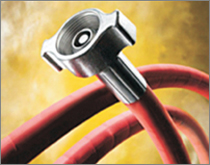
Finn Power machines, built by Lillbacka in Finland, have been around in those workshops for decades. They sit in a category of equipment that engineers tend to trust without thinking too hard about why. So let’s look at the actual reasons for their rock solid reputation.
Steam Hoses Ask More From a Crimp Than Most People Assume
Steam hoses carry saturated steam at temperatures that can sit above 200°C, often at working pressures around 17 to 18 bar. The tube and cover are usually EPDM or chlorobutyl rubber, with one or two layers of steel wire braid sandwiched in between. The coupling has to grip all of that without crushing the inner tube or losing its hold once thermal expansion kicks in.
Too loose and steam leaks. Too tight, and the hose fails at the ferrule under thermal cycling. That narrow window is where the machine earns its place.
Crimp Force You Can Actually Control
A Finn Power crimping machine applies radial force through a set of eight dies that close around the ferrule together. The force is hydraulic, and a mechanical stop sets the final closing diameter rather than operator feel. You dial in the crimp diameter to within tight tolerances, often a tenth of a millimetre on production models.
For steam couplings, that precision counts twice over. Hose makers publish exact crimp diameters for each ferrule and hose combination. Hitting the target within a tight tolerance keeps the assembly within its rated pressure cycle life. Miss it by a few tenths, and the safety factor you assumed on paper starts disappearing.
Repeatability Across Long Production Runs
Workshops fabricating steam hoses for refineries, paper mills, or food plants tend to produce in batches. Twenty assemblies one day, sixty the next. Each one needs to come out the same.
Finn Power machines store crimp specifications in memory. After initial setup, the operator selects the recipe, and the machine returns to the same diameter on the next assembly. There’s less drift between the first piece and the last one.
Some workshops still measure every crimp with a micrometre. Even then, an electronic stored setting reduces the chance of a wrong setup at the start of a run. Operators get tired, shifts change, and memory functions take some of that human variability out of the equation.
Where the Machine Fits Into Safer Assemblies
Steam couplings often need a secondary safety device, like a bolted clamp or a whip check. The consequences of a steam failure run high. The crimp itself stays the main holding force, though. A consistent, in-spec crimp from a Finn Power machine gives the rest of the safety system something solid to back up.
Specifying equipment for a hose shop that works on steam lines means looking at this kind of detail. The crimper alone won’t make an assembly safe. It just makes one of the more error-prone steps less likely to fail on you under pressure. Most workshops working with steam keep an inspection log alongside, recording each crimp diameter against the spec sheet. A machine that holds its setting between assemblies makes those logs easier to fill in accurately.
Featured Image Source: https://www.jreltd.com/images/utility-hoses/pic8.jpg


