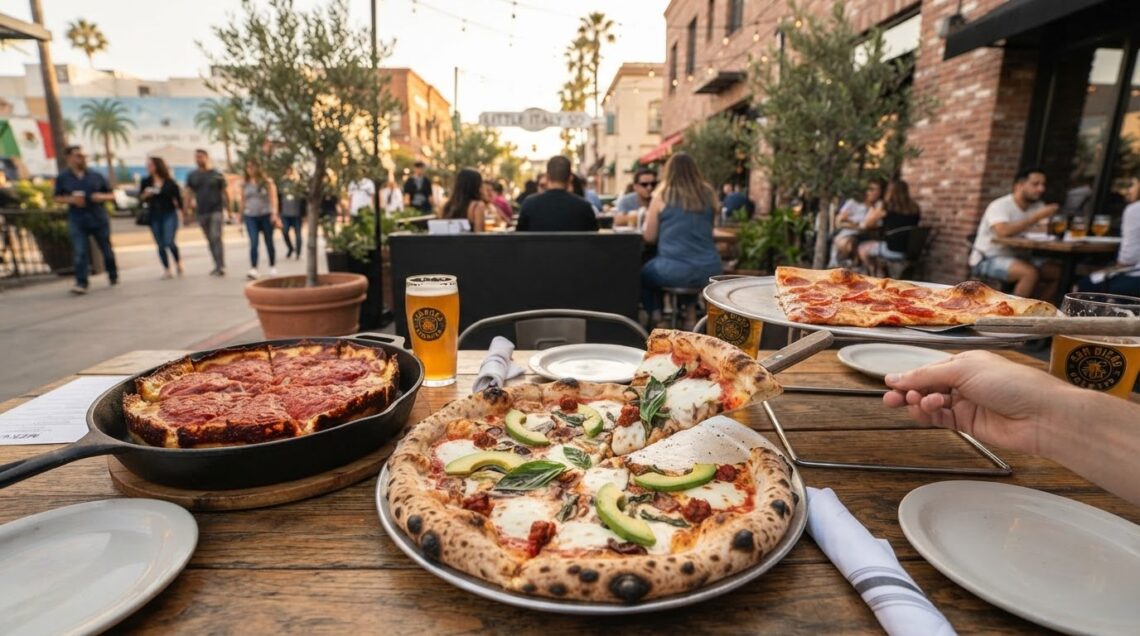
San Diego is known for fish tacos, sunshine, and a craft beer scene that rivals much larger cities, so pizza can easily get overlooked. Yet ask a local where to find a good slice, and the answer depends on what you want: a deep, cheese-heavy pie that works as dinner, a blistered Neapolitan on a patio, or a foldable New York slice eaten on the walk home. The city’s pizza scene borrows from Chicago, Naples, New York, and Mexico, then adapts each style to its own produce, weather, and neighborhoods.
Searches for best pizza san diego usually reflect a practical question, not a ranking exercise. Most diners want to know which style will satisfy their appetite, which kitchen fits the occasion, and what to order once they arrive. Those are the questions this guide answers, starting with the thick-crust end of the menu and moving toward thinner, faster-cooked pies. Price ranges below are typical for the region and vary by size, toppings, and dining room.
Operators such as Seaside Pizza Co show how a single kitchen can make a clear stylistic choice and carry it through the menu. When evaluating any pizzeria, ask what the dough is made from, how long it ferments, and what oven it uses. A kitchen that can explain its dough hydration, proof time, and bake temperature is usually more consistent than one that relies on toppings to carry the pie.
Deep Dish and Sicilian: The Thick-Crust Side of the City
Thick-crust pizza is the most indulgent option on San Diego menus. A single slice can function as a full meal, and the style rewards diners who want structure, richness, and a long, slow bake.
Deep Dish Construction and Who Does It Well
Deep dish, usually associated with Chicago, is built in a deep, oiled steel or cast-iron pan. The dough is pressed up the sides to form a tall wall, and the construction order is the key difference from other styles. Mozzarella goes down first, directly on the dough, followed by fillings such as sausage or vegetables. Sauce, typically a chunky tomato, sits on top. This arrangement protects the cheese from direct pan heat, which would otherwise scorch it during a bake that often runs 30 to 45 minutes at roughly 425 to 450°F.
The pan and the dough do the structural work. A sturdy, fat-enriched dough holds its shape against the weight of cheese and toppings, and the walls set as they bake. Overproofed dough collapses, while underproofed dough stays dense and doughy in the center.
Because the style is so specific, kitchens differ in their choices more than in their basic method. Some lean into a buttery, sturdy crust with generous cheese and a sauce that is heavy on tomato and herbs. Others produce a lighter crumb with a thinner cheese layer so the toppings stand out. Expect a 9- to 12-inch deep dish to cost roughly $22 to $35, and allow 40 to 50 minutes for it to come out of the oven. Order early or plan for a longer meal. When comparing kitchens, ask whether the pie is made to order or pre-assembled, since that affects both texture and wait time.
Sicilian Squares and What Makes Them Distinct
Sicilian pizza is often confused with deep dish, but the differences are visible at the counter. Sicilian pies are baked in rectangular pans, usually in larger sheets that are cut into squares and sold by weight or by piece, commonly $4 to $7 per square depending on toppings.
The crumb is the defining feature. Sicilian dough is typically proofed longer and pressed into an oiled pan, producing a rectangular, focaccia-like interior that is open, airy, and chewy, with a crisp, golden bottom. The crust is thick, but it is more bread-like than the dense, buttery walls of deep dish. Sauce is often spooned on top after baking or added in the final minutes, and cheese may sit beneath it or be sprinkled over the surface.
For a quick check at a counter, look at the shape and the top. A round pie with a tall wall, cheese beneath the sauce, and a long bake is deep dish. A rectangle with a bread-like crumb and sauce above the cheese is Sicilian.
Thin, Blistered, and Coastal: Neapolitan and New York Influences
At the other end of the spectrum, thin-crust styles suit San Diego’s mild climate and outdoor dining culture. These pies are lighter, faster to cook, and easier to eat with one hand while sitting on a patio.
Neapolitan pizza is made with finely milled 00 flour, a wet, minimally kneaded dough, and a very hot oven, often wood-fired and running near 800 to 900°F. A proper Neapolitan pie cooks in roughly 60 to 90 seconds, producing a soft, pillowy rim (the cornicione) and dark leopard spotting on the crust. New York-style pizza is hand-stretched into a wider, thinner round and baked in a deck oven at a lower temperature, usually 500 to 600°F, for six to ten minutes. The result is a crust that is crisp underneath and pliable enough to fold.
These styles let fresh ingredients show. A thin base puts tomato, basil, and seasonal greens in direct contact with the heat, so their flavor comes through rather than being buried. Arugula added after the bake keeps its color and bite, while greens placed before the oven wilt quickly. Expect Neapolitan pies to run about $16 to $24 and New York-style slices to range from $4 to $6, though full pies are typically $18 to $28.
A simple way to match a style to your appetite:
- Char: Neapolitan offers the most pronounced blistering and smoky flavor. New York-style has lighter browning.
- Chew: Neapolitan is soft and elastic. New York-style is crisp at the base with a chewy interior.
- Fold: New York-style is built for folding. Neapolitan is usually eaten with a knife and fork.
Toppings That Read Like a San Diego Menu
Classic toppings remain the backbone of most menus. Pepperoni, sausage, mushroom, and onion continue to be the most common choices across the city, and they perform well on every style in this guide. Pepperoni crisps and cups in thicker pies, while Italian sausage adds fat that balances tomato acidity.
San Diego’s Mexican influence appears most clearly in the adventurous end of the menu. Chorizo brings paprika-driven heat and rendered fat, roasted poblano adds smoky sweetness and mild spice, and crumbled cotija provides a salty finish when added after the bake. Avocado is a common finishing topping, but it should typically go on once the pie leaves the oven. Heat will brown it quickly and dull its color.
Seafood is another local signal. Shrimp and anchovy appear on many menus, reflecting the city’s coastal access. Shrimp needs careful moisture control, since excess water from frozen or poorly drained product can make a thin crust soggy. Anchovy works best in small amounts, where its salt and umami support tomato and garlic rather than overpowering them.
The most successful combinations tend to follow a simple logic: one bold element, one fresh element, and a base that can carry both. A chorizo and poblano pie on a sturdy crust works well. Mushroom and arugula on a thin Neapolitan base highlights texture and freshness. Adding too many strong toppings to a thin crust usually leads to a soggy center.
Neighborhood Pizza Walks: Little Italy, the Gaslamp, and Beyond
Pizza in San Diego is shaped as much by where it is eaten as by what is on the plate. Each neighborhood has its own pace and expectations, which can help you decide which style to order.
Little Italy has historic Italian roots, and its restaurants lean toward sit-down dinners, longer meals, and classic preparations. This is the right setting for a deep dish or a Neapolitan pie you plan to linger over with a bottle of wine or a local craft beer.
The Gaslamp Quarter is built around nightlife, and its pizza reflects that rhythm. Faster-service counters and late-night slices suit New York-style pies, which can be eaten standing up or on the move. A foldable slice is practical when the evening runs past dinner.
Beach-town neighborhoods such as Pacific Beach, Ocean Beach, and Point Loma have a relaxed, casual character. Patios and sun-warmed afternoons make thin, blistered pies and fresh-topped Neapolitan styles a natural fit. Order something light enough to share and leave room for a walk on the sand.
Matching the style to the outing helps:
- Sit-down dinner: Deep dish or Neapolitan with a full bottle or pitcher.
- Night out: New York-style slices or Sicilian squares for quick, portable food.
- Beach afternoon: Thin pies with fresh greens, eaten at a patio table.
San Diego also has practical rules that affect the experience. Local food facilities are inspected by the County of San Diego Department of Environmental Health and Quality, and under California law, food employees generally must hold a food handler card, which is a standard requirement for kitchen staff. These are baseline standards, but they are a useful reminder that a clean, well-run kitchen is a reasonable expectation everywhere in the county.
Pizza Within San Diego’s Wider Food Scene
San Diego is widely known for fish tacos, fresh seafood, burritos, and a craft beer culture with a strong hop focus. Pizza fits into that landscape as a counterpoint rather than a competitor.
Pizza pairs well with the city’s beer. Hoppy pale ales and IPAs cut through the richness of sausage, cheese, and cured meats, while a lighter lager suits simpler Neapolitan pies with fresh basil and tomato. Darker, malty beers complement roasted poblano and chorizo, since their caramel notes echo the smoky spice.
Pizza also works as a break from a taco-heavy day. After a long afternoon of fish tacos and burritos, a thin, lightly dressed pie offers a different texture and a change of flavor without feeling repetitive. The reverse is also true: a deep dish or Sicilian square makes a satisfying anchor for a day built around small plates and seafood.
This flexibility reflects the city’s broader food identity. San Diego borrows freely from Mexican, Italian, Asian, and coastal traditions, and pizza is one of the clearest examples. The best pizza in the city is less about adhering to a single regional rule and more about how well a kitchen adapts a style to local produce, local tastes, and the neighborhood it serves.

